
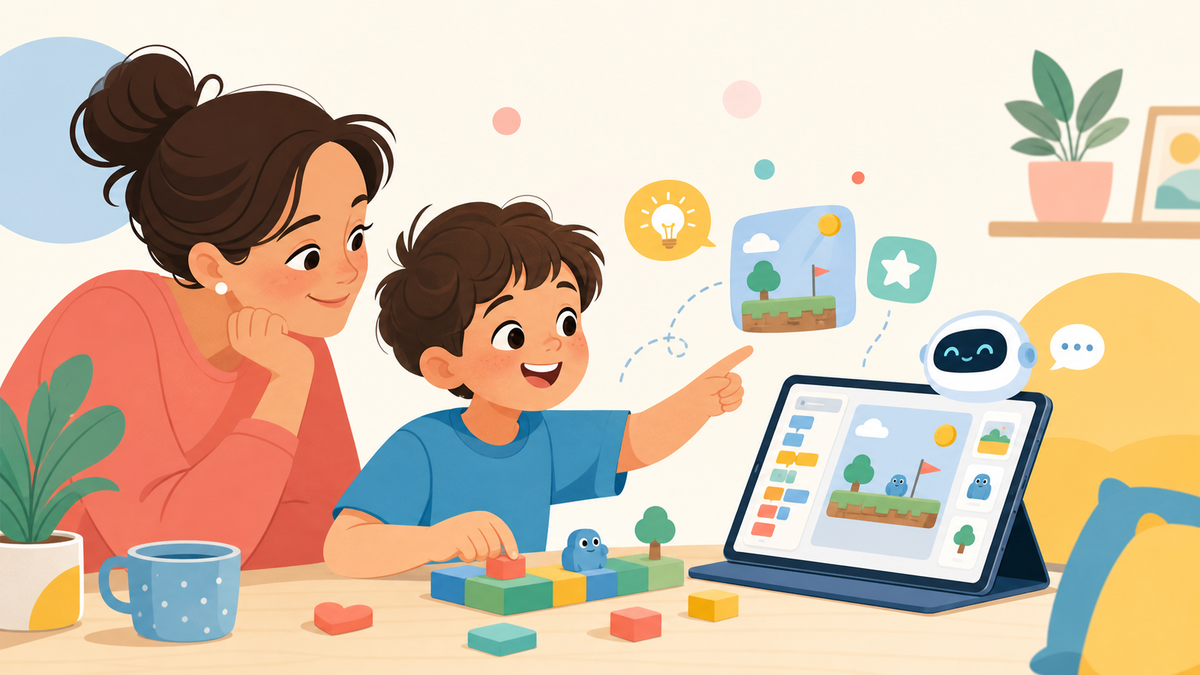
Many Sydney parents still carry an understandable picture of what “serious” coding should look like. It can sound more rigorous if a child starts by memorising commands, copying syntax, and getting comfortable with rules before they are allowed to build something fun. On paper, that approach feels disciplined. In practice, it often creates the opposite of what parents want. Instead of building confidence, it can make coding feel abstract, fragile, and easy to get wrong.
For most beginners, children learn AI and coding better when they are building a small game from the start. That does not mean structure disappears or that syntax stops mattering. It means the child gets a reason to care about the structure. The code, prompt, or logic change is attached to something visible: the character moves, the score updates, the obstacle speeds up, or the game feels more fun. That sense of cause and effect is what turns technical concepts into real learning.
This is one reason our Snake game guide works so well as a first project. It gives children a concrete goal, quick feedback, and a reason to keep improving version two. The child is not memorising in the dark. They are building toward something they can test, explain, and show you afterwards.
Why syntax-first learning can stall beginners
Syntax matters. There is no point pretending otherwise. Children do need to learn how instructions are structured and why precision matters. The problem is timing. When syntax arrives before purpose, beginners often experience it as a wall of rules they have not earned yet.
A child who has never built a game rarely feels excited by punctuation, parameter order, or command spelling on their own. Those details become meaningful later, once the child has seen what a better instruction can do. If the first experience is mostly “remember this format or it breaks”, many children stop reading the exercise as creativity and start reading it as avoidance.
Parents sometimes misread that moment. They assume the child is not suited to coding, when the bigger issue is often that the learning sequence is backwards. The child needed a reason to care first. A working project gives them that reason.
What building a game gives a child straight away
When a beginner builds a small game, every technical idea lands inside a visible loop: idea, try, test, fix, improve. That loop is far more natural for children than “remember this rule because it will matter later”. It also fits the way AI should be introduced to them: as guided support inside a real project, not as a machine that takes over.
- Ownership appears early. The child has a goal that feels personal, even if the project is simple.
- Feedback is immediate. They can see what changed, which makes mistakes feel useful rather than mysterious.
- Debugging becomes normal. A game that is slightly wrong invites fixing, not quitting.
- Motivation lasts longer. Children are far more willing to refine something they actually want to play.
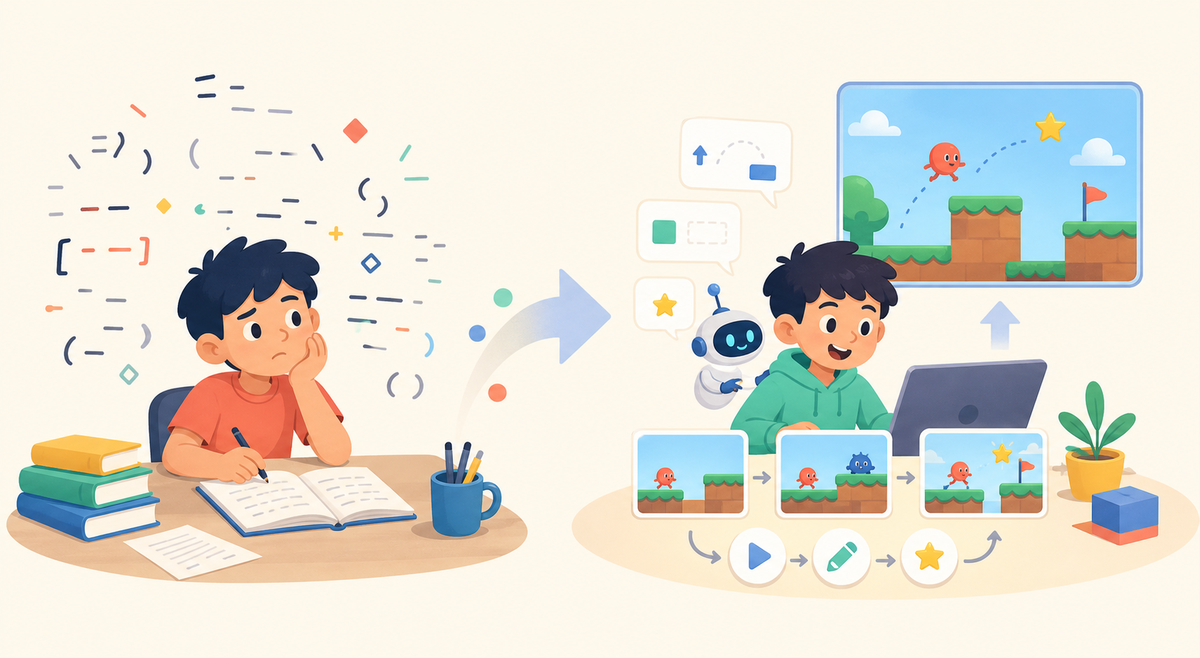
That is also why game-building works so well for AI literacy. A child can ask for help, compare the suggestion to what they meant, test the result, and revise. In other words, they are learning judgement as well as mechanics. If you want that distinction in plain English, our guide to AI as a coach, not a ghostwriter explains what parents should look for.
Games make abstract thinking visible
Children often understand more than adults expect once the idea is visible. “If the character touches the wall, lose a life” is logic. “Increase speed after ten points” is logic. “Make the jump feel smoother” is logic. These are real programming decisions, but they do not arrive disguised as a worksheet. They arrive as something the child can see and feel on screen.
That visibility matters because it helps children connect effort with outcome. A child changes one instruction and the result is obvious. They are not guessing whether the concept mattered. They can feel the game respond. For many beginners, that is the moment coding starts to make sense.
It also creates better conversations at home. Parents do not need to decode a page of unfamiliar syntax to understand progress. A child can say, “I changed the enemy timing,” or “I fixed the scoring,” and you can immediately see what they mean. That makes it easier to support the learning even if you are not technical yourself.
Why this matters even more in the age of AI
AI lowers the barrier to starting, which is useful, but only if the child is still doing the thinking. A blank editor is intimidating for many beginners. AI can help them move faster from idea to experiment. The risk is that a child becomes passive and lets the tool supply too much of the project.
Game-building is one of the best protections against that passivity because the project naturally demands choices. What should the player do? How should the level feel? Is the difficulty fair? What should happen next? Those decisions keep the child in the driver’s seat. The AI can help with suggestions and clarification, but the project still needs the child’s judgement to become enjoyable.
That is a much healthier start than teaching a child to accept generated answers without understanding them. The goal is not to avoid AI. It is to give AI the right role inside the learning loop.
This is not anti-syntax. It is about sequence.
Parents sometimes hear “build games first” and worry that the learning will stay shallow. It should not. Strong programs still teach precision, structure, and code quality. The difference is that they introduce those ideas when the child has enough context to absorb them.
Once a child has built a few small mechanics, syntax stops feeling like random ceremony. It becomes the tool that lets them get the jump arc right, fix the collision, or improve the level flow. At that point, accuracy matters because the child has something they care about protecting.
If you are still choosing the best starting format, our comparison of Scratch, Python, and AI-assisted coding can help you match the tool to your child. The deeper principle stays the same whichever path you choose: learning sticks better when the child is building something meaningful.
What Sydney parents should look for in a program
If a provider says children learn through projects, look more closely at what that means. Not every “project-based” class keeps the child in charge. A strong beginner environment should make the project concrete, the feedback fast, and the child’s decisions visible.
- Ask what a child actually builds in the first session. You want a real outcome, not only theory.
- Check whether the child is expected to revise and debug. Improvement matters more than first-pass polish.
- Ask how AI is used. It should support the child’s thinking, not replace it.
- Listen for ownership. Good classes talk about choices, testing, and iteration, not just finished output.
When those pieces are in place, game-building stops being a gimmick and becomes a strong teaching format. It gives children a practical reason to learn logic, a safer way to make mistakes, and a better chance of staying engaged long enough for the deeper concepts to land.
If you want that kind of start, explore our Airbotix programs. They are designed around the same principle: children learn best when they are actively building, thinking, and improving, with AI in the role of coach rather than ghostwriter.