
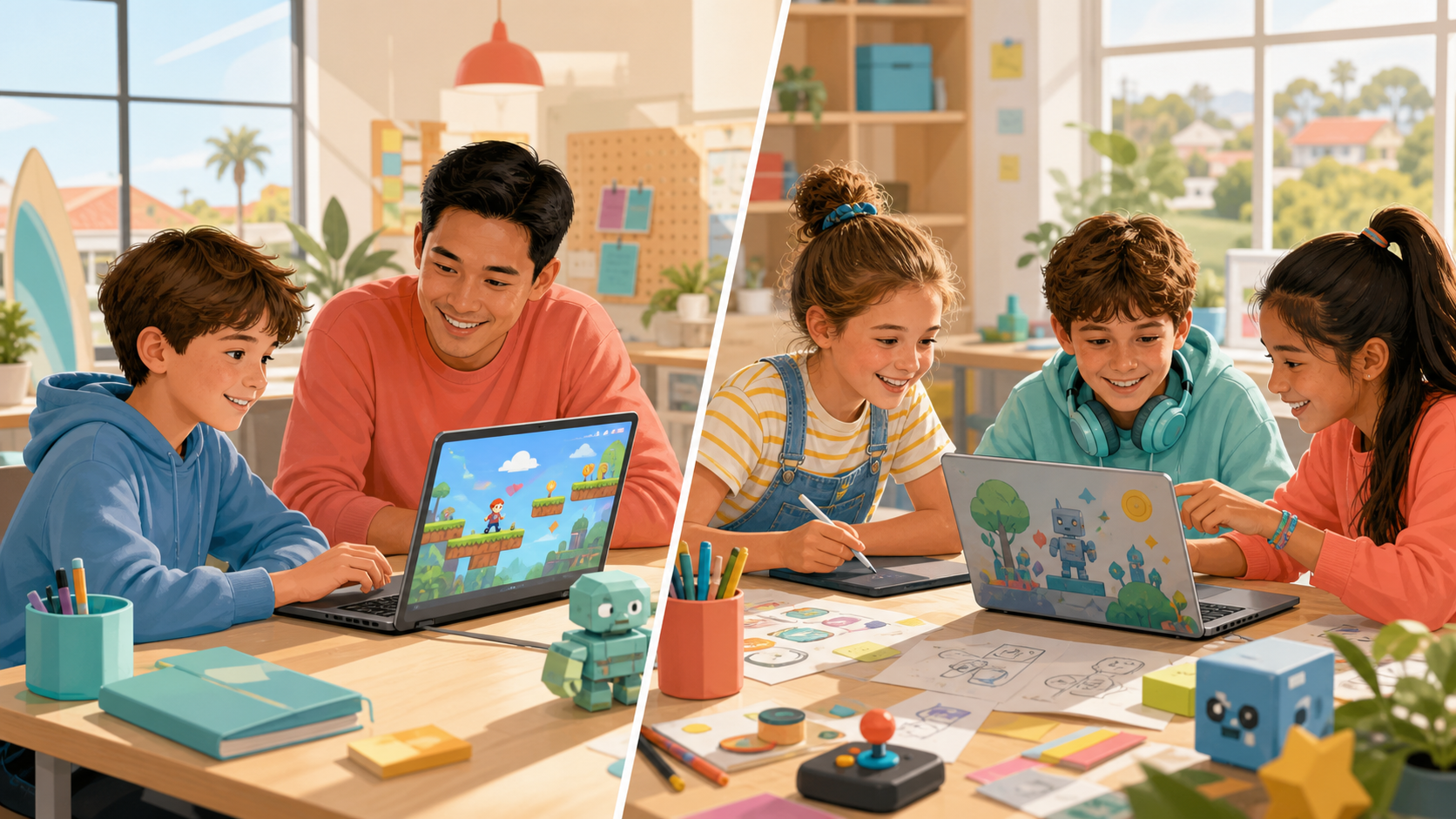
For many Sydney and NSW parents, the question is not whether their child should learn AI and coding, but how to start. Should you book weekly after-school AI coding classes, or is a school-holiday workshop the better first step? Both can work well. The right fit depends on your child’s energy, confidence, routine, and how they like to learn.
At Airbotix, we see both formats help children grow when the learning is hands-on and the child stays in charge of the building. The goal is not to sit back while AI does the work. The goal is for your child to use AI as a coach: asking better questions, testing ideas, fixing mistakes, and turning a blank screen into something they are proud to show you.
What after-school AI coding classes are best for
After-school classes usually suit children who benefit from rhythm, repetition, and smaller wins over time. Instead of trying to do everything in one burst, they return each week, pick up where they left off, and steadily build capability.
- Routine helps reluctant starters. Some children need a few sessions before they relax enough to experiment. A weekly class gives them space to settle in.
- Skills compound naturally. One week your child learns movement logic. The next, they add scoring. Then they debug collisions, tweak game feel, and make creative choices.
- Confidence grows without pressure. A child who is unsure about coding often does better when the pace feels manageable and familiar.
- It works well for busy terms. Families can fit a regular class into the school-week rhythm without turning holidays into another packed schedule.
If your child likes structure, tends to warm up slowly, or enjoys building mastery step by step, weekly sessions are often the better long-term fit. They are especially useful for children who do not yet see themselves as “technical”, because the repetition removes the feeling that they must get everything right immediately.
What school-holiday workshops are best for
School-holiday workshops are different. They compress momentum into a shorter window, which can be brilliant for curious children who love diving deeply into a project. Instead of waiting a week between sessions, they stay immersed and often leave with a more complete game or a clearer sense of what they enjoy.
- Fast momentum keeps excitement high. Children can make visible progress quickly, which is motivating when they are trying something new.
- They suit project-minded kids. If your child likes going all-in on Minecraft, drawing, Lego, or a favourite game idea, an intensive format often feels natural.
- They can be a clean trial. A workshop lets families test fit and interest without locking into a weekly routine straight away.
- Holidays create room to focus. Without homework and school-day fatigue, some children are more willing to persist through bugs and iterate properly.

A holiday workshop is often a strong choice for children who want a burst of creative energy, or for parents who want to see a real project outcome before deciding what to do next. When the workshop is built around making something tangible, it can turn abstract “coding” into a very concrete feeling of I made this.
How to decide which format fits your child
Parents usually make the best decision when they ignore the marketing labels and think about the child in front of them. Ask yourself a few practical questions.
- Does my child enjoy routine or intensity? Some children thrive on predictable weekly progress. Others prefer a deep creative sprint.
- How confident are they with new tools? Beginners who get overwhelmed easily may prefer the gentler cadence of after-school classes.
- What is term time already like? If afternoons are already crowded with sport, tutoring, and commuting, a holiday workshop may be the less stressful entry point.
- What motivates them more: process or outcome? Children who love ongoing improvement often enjoy weekly classes. Children who need a visible result quickly may respond better to a workshop.
There is also a practical family question: are you looking for a one-off confidence boost, or a habit that builds over months? Those are different goals, and it is worth being honest about them.
What actually matters more than the format
The format matters, but the teaching model matters more. A mediocre weekly class will not become effective just because it runs for a term. A flashy workshop will not help much if the child mostly watches instead of builds.
What parents should look for is a program where children actively make decisions. They should be describing what they want, checking the AI’s suggestions, spotting what is wrong, and improving the project themselves. That is why our approach is grounded in learn-by-building. Children do not memorise disconnected commands first. They build real games, starting small, and learn the concepts because the project gives those concepts a purpose.
This also connects to a wider parent concern: if AI can write code, what is my child actually learning? We covered that in more depth in Is Coding Still Worth Learning for Kids in the Age of AI?. The short answer is that judgement, persistence, decomposition, and creative direction matter more than ever. A strong class or workshop should strengthen those habits, not replace them.
A simple rule of thumb for parents
If your child is cautious, easily discouraged, or already carrying a heavy school-week load, start with after-school classes. If your child is highly curious, wants a quick win, or you want a lower-commitment way to test interest, start with a holiday workshop. Neither choice locks you in forever.
In fact, many families do both over time. A child might begin with a holiday workshop to spark interest, then move into weekly sessions to deepen skill and consistency. Another child might start with weekly classes, then use school holidays for bigger creative leaps when they are ready.
The best first step is the one your child will repeat
Parents sometimes feel pressure to choose the “perfect” program. Usually, the better question is simpler: which format is most likely to help my child enjoy the first experience enough to come back? That is the moment that matters. Once a child feels agency, pride, and momentum, real learning has started.
If you are weighing up options now, browse our Airbotix programs and look for the format that matches your child’s energy, not someone else’s idea of the ideal learner. The most useful start is the one that gets them building.